
POINT OF VIEW
Beyond the Sun Gate
Beyond the Sun Gate
On a journey to Peru’s Sacred Valley, writer Alexandra Marvar uncovers the lesser-known chapters of the ancient Incan mystery.
BY ALEXANDRA MARVAR
Our guide, JJ, leans against a railing at an overlook. Behind him, the earth drops away into what appears to be a massive amphitheater. After spending the morning in an Incan village—its original buildings, streets, and irrigation channels still in use, in the shadow of a sprawling, imperial fortress—we’re now standing at the edge of another Incan site: Moray.
This is one of more than half a dozen Incan archaeological marvels here in Peru’s Valle Sagrado, Sacred Valley of the Incas. Machu Picchu is far and away the best-known (and for many people, the only-known) ancient site in this region of south-central Peru. To my surprise, it has more than one rival for the title of “most remarkable.”
Moray is defined by meticulous, circular walls arranged in concentric rings. The top ring is nearly as wide across as two football fields laid end to end. The rings grow smaller and smaller as they sink into the ground, spiraling downward like a drain of stone and sod. A hundred feet below, the tiniest ring is a circle of grass about the size of a backyard swimming pool.
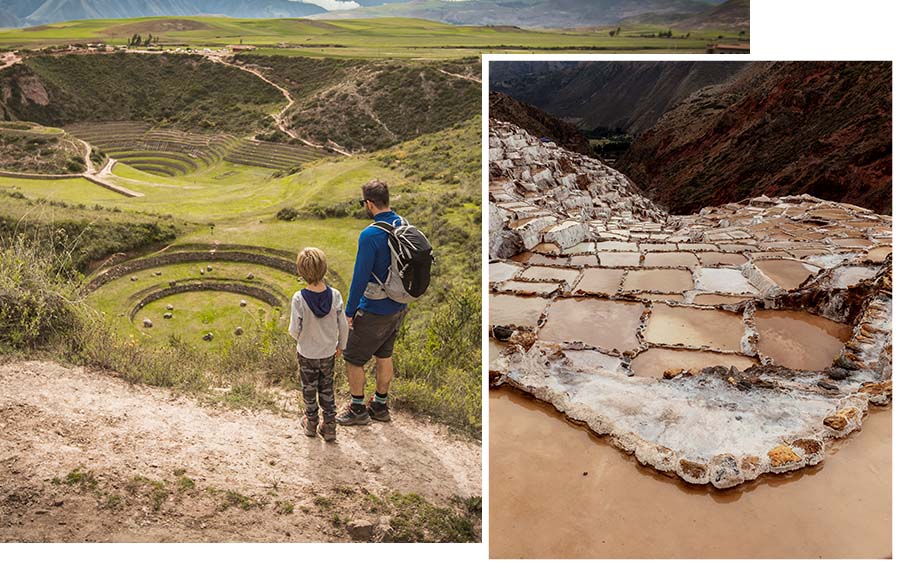
Why is it here? No one seems to know. Halfway into our four-night stay with Abercrombie & Kent at Explora Lodge Valle Sagrado, how little we know about these ancient sites is an emerging theme. Explora is renowned for its expertly guided expeditions, designed to give guests a deeper sense of the region around Machu Picchu. Our guides, who grew up here, have shown us around other breathtaking Incan sites, including the mountainside complex of Pisac, and the living Incan village of Ollantaytambo, which, tomorrow, we’ll revisit to catch a train to Machu Picchu. Each of these sites is unique—from one another and from anything I’ve ever seen before. Yet they all evoke that theme of mystery: There are no books, letters, architectural drawings, or written records whatsoever to explain them. The entire continent-ruling Incan empire disappeared mere decades after the Spanish arrived in Peru, and their reasons for constructing these feats of engineering disappeared with them.
“Our guides, who grew up here, have shown us around other breathtaking Incan sites, including the mountainside complex of Pisac, and the living Incan village of Ollantaytambo…”
Of course, there are theories. Wind is buffeting JJ’s hood and ruffling his hair as he runs through them in Quechua-accented English. Early archaeologists believed Moray was agricultural. Seeds of a precious plant from many miles away in the Amazon—coca—were discovered here, and the terraces vary in temperature by one to two degrees, getting warmer as they go deeper. Was Moray built as a series of irrigated microclimates for cultivating the coca thought to have fueled millions of workers as they built the valley’s sites out of inconceivably massive, interlocking stone blocks?
The second theory, JJ says, frames Moray as a religious site. A meteorite enters the list at some point, too. Finally he addresses what many travelers can’t help but think: aliens. Each site we’ve visited has been its own tangle of mysteries … that may never be solved.
Early the next morning, a 45-minute van ride brings us to bustling Ollantaytambo. Fog clings to terraced ruins on the mountainside. At the train station, I board the PeruRail and find my assigned seat at a four-top table. Our 27-mile journey along the Urubamba River begins.
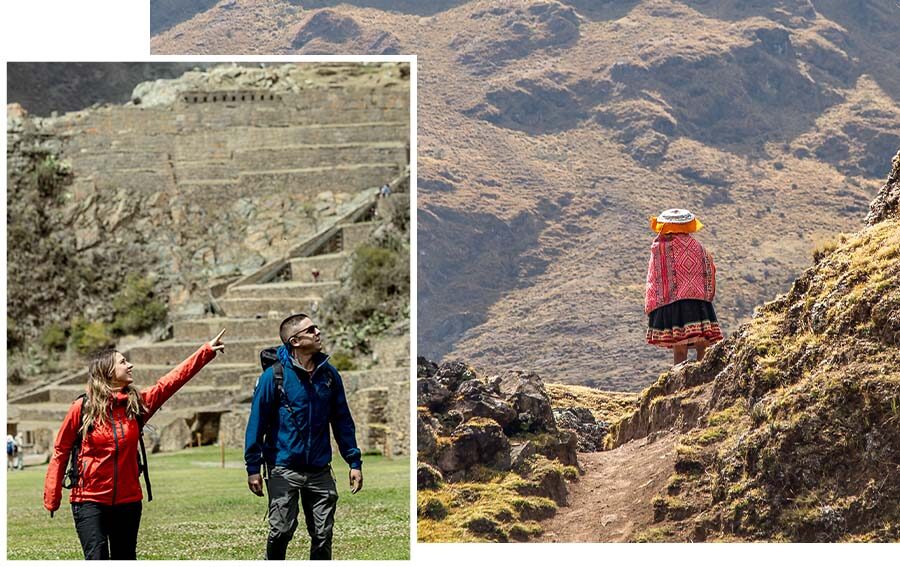
In the Sacred Valley, there are only two seasons: rainy and dry. It’s August—dry season—and the arid landscape is a monochrome of browns. We barrel through mountain tunnels. Suddenly, everything changes. We’ve crossed some sort of invisible, ecological border. Brown gives way to vivid green: the Amazonian cloud forest. We reach Machu Picchu’s basecamp town, Aguas Calientes.
Weeks before departing for Peru, the A&K team secured my time-stamped admission ticket to one of four set routes defined by the Peruvian government. They nabbed me the only route that was still available for the date I was visiting: Circuit 1, known for the “classic view” of the site—the one you’ve seen in National Geographic. The team at Explora paired me with a favored Machu Picchu guide, Lizbeth, who says she has made the super-steep, always-full, 30-minute bus journey from Aguas Calientes up and down the mountain well over 1,000 times.
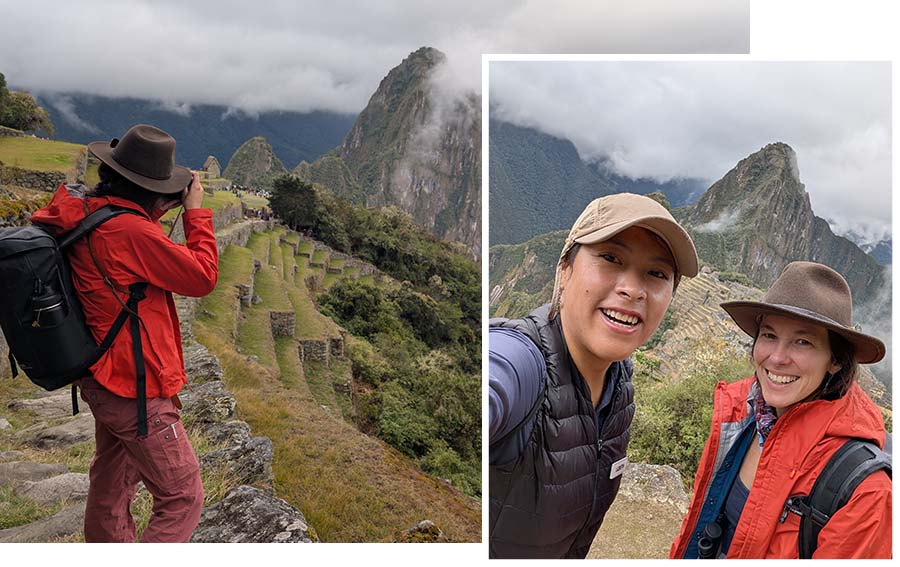
My route also includes access to a mountain lookout on an opposite peak: Intipunku, the Sun Gate. I’m eager for that quintessential sight, but Lizbeth suggests taking the hour’s hike to Intipunku first. Consequently, my first glimpses of Machu Picchu are back over my shoulder—from the steep, curving trail—as it’s disappearing behind us. A rare rain shower threatens to obscure our view entirely. But Lizbeth’s plan is brilliant: We have this 600-year-old footpath virtually to ourselves, and there’s something thrilling about prolonging the anticipation. When we reach Intipunku, our vantage is the one that hikers have when they finally arrive, after days of walking. Winded and rainsoaked, I feel my own sense of accomplishment. The clouds part. Tears fill my eyes. Ancient architecture spills up and down massive, verdant peaks and slopes, stone terraces reaching skywards and plummeting into the valley. “Isn’t it amazing?” Lizbeth asks. “For me, every time I see it is like the first time.”
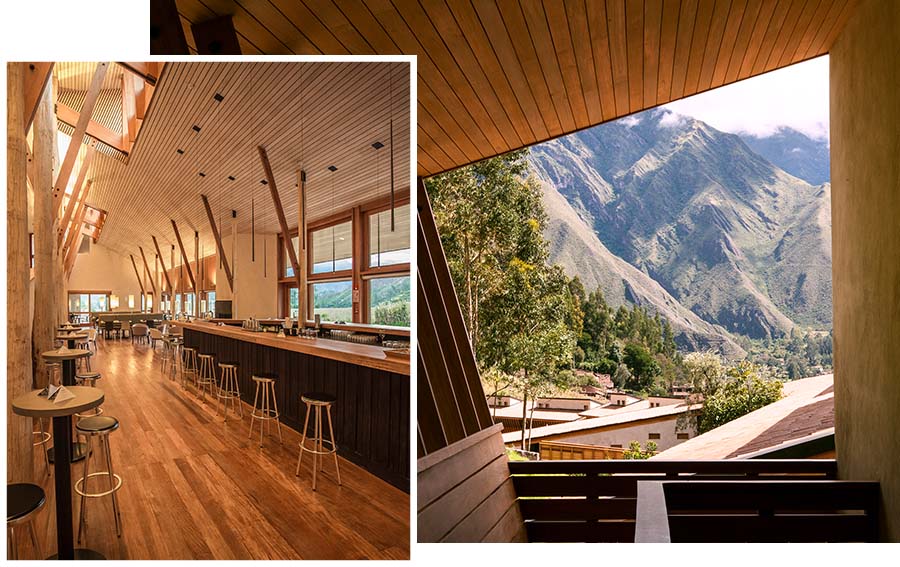
That night at the lodge, I order Explora’s variation on a pisco sour—mixed with Ollantaytambo-made digestif matacuy, Quechua for “guinea-pig killer” because it’s often paired with roasted guinea pig, a local delicacy. I watch the sun set over the quinoa flowers outside the lounge windows. Then I flip through my photos.
Today I saw in person something I’ve seen in pictures my whole life: that iconic, postcard-perfect view of the Incas’ lost citadel—but in full context. Nothing had prepared me for its staggering size and scope. And, thanks to Lizbeth’s expertise navigating this well-trod place, I got to take it in with a seemingly impossible sense of solitude, as if we’d stumbled upon it for the very first time. I was awestruck by Machu Picchu, a feeling vastly magnified by the places I experienced before and after. Cusco’s imperial architecture. Moray’s terraces. Ollantaytambo’s fortress, towering above living Incan streets. Machu Picchu is a world wonder, but it doesn’t exist in isolation. It’s the exclamation point at the end of the Incas’ long, gripping mystery story.
MORE STORIES
What to Read Next
What to Read Next
Room Key
Our Hotels & Resorts Collection brings elevated stays and seamless luxury to destinations across the globe.
Cruise GPS
Oceania Cruises brings every destination to life through immersive epicurean adventures and hands-on learning.
New & Noteworthy
Explora Journeys’ newest ship, EXPLORA III, sets a bold new standard for space, comfort, and wellbeing at sea.